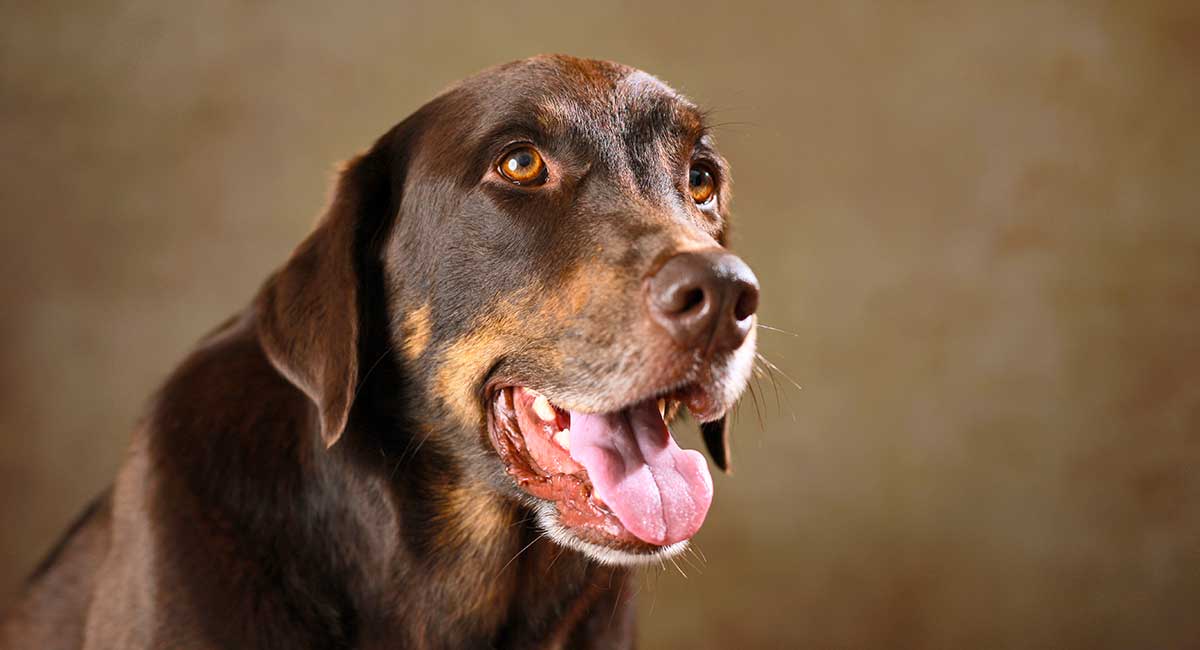
The Labrottie is a puppy that is a cross between a Labrador Retriever and Rottweiler.
Where Does the Labrottie Come From?
Both parent breeds are large, robust dogs that do well in pet and working roles. Their temperaments are distinctive due to generations of selection for particular roles.
The Labrador was developed as a gun dog to help with hunting, and the Rottweiler was a livestock protection dog now often used as a guard dog.
Labrottie Appearance
Unlike some crossbreeds, the Labrottie’s appearance is very close to a blend of the parent breeds. Although some more closely resemble a Labrador Retriever and some a Rottweiler.
The Labrottie is typically black or black and tan (called ‘saddle tan’), although a few have shown up with red or gold coloring.
In terms of appearance, they have a short coat and hanging ears. They also have a large, robust frame and will weigh between 55 and 135 pounds with males being larger than females.
Labrottie Temperament
While there are physical similarities between Labradors and Rottweilers, they come from breeds with very different jobs and so different temperaments.
Owners generally report easy going and friendly dogs, but some note a tendency to guard or protect. This might be related to the development of the Rottweiler as a dog to protect livestock and property.
Training Your Labrottie
Socialization and training are essential for all dogs, but especially those that are large, energetic, and intelligent.
If your puppy resembles the Rottweiler, you should bear in mind that this breed is feared by some who consider them aggressive. This means it’s even more critical to be a responsible pet owner to help fight this stigma.
Both Labrador Retrievers and Rottweilers are highly trainable when compared to a range of other breeds.
As they have been raised for many generations as working dogs, ensure your Labrottie has plenty of opportunities for mental and physical activity. Otherwise, they tend to make up their own entertainment, which often involves chewing on things.
Labrottie Health
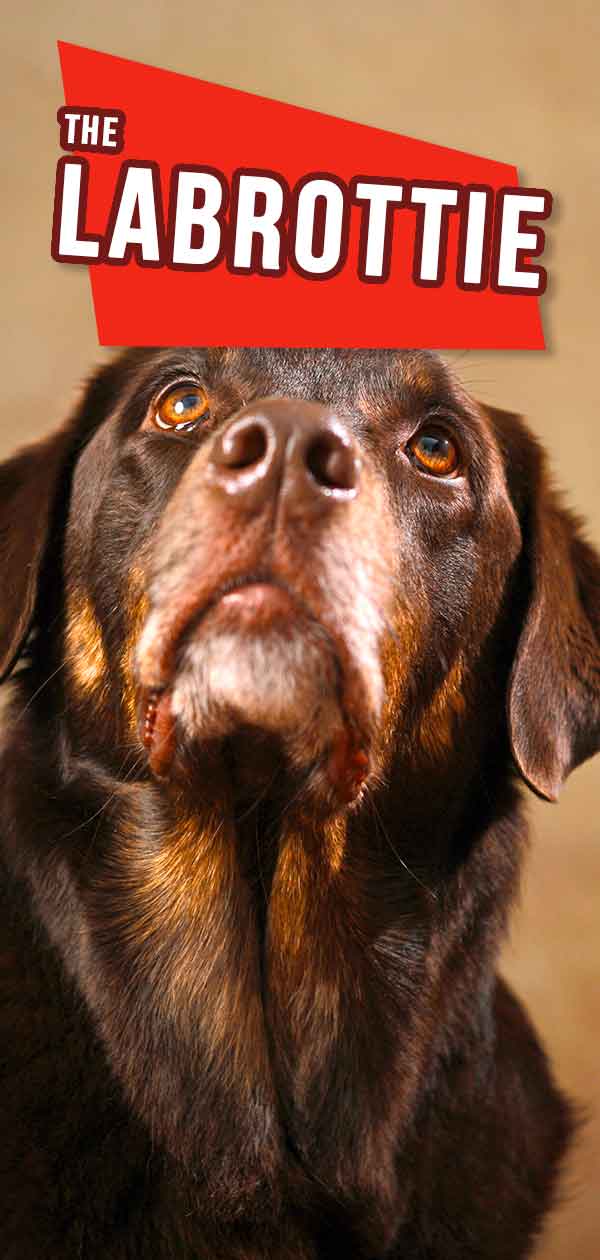
Both parent breeds are large dogs prone to health problems, including degenerative joint disorders (e.g., hip and elbow dysplasia), and obesity.
Since the 1980s inbreeding has become less of a concern in purebred Labradors Retrievers and Rottweilers. Breeding plans have also reduced the effect of inherited disorders. With hybrid dogs, as with purebreds, it is preferable to breed from dogs that have been health screened.
The Labrottie should be expected to have a typical lifespan for a larger breed of 9 to 12 years.
Major health concerns are also related to being a large active dog. Large breed puppy food should be provided to avoid overly rapid bone growth and deformation.
As your puppy gets older, it is important to prevent obesity, which can put further strain on their joints.
Do Labrotties Make Good Family Dogs?
Labrotties can be a great family pet. As they are large and energetic, care should be taken when introducing this dog to children.
When raising a puppy, ensure that they are well socialized and trained and all family members are taught how to behave.
Rescuing a Labrottie
Labrottie puppies are often available in general shelters and from websites such as PuppyFinder.
Be cautious when adopting an adult large dog and introducing them to your family and other pets.
Seek out shelters and fosters that can tell you about the dog’s personality and any special needs. This will ensure they are a good match for your family.
Finding a Labrottie puppy
Very few breeders specialize in the Labrottie. You will find them advertised but care should be taken in proceeding with private adoptions as the origin and health of the puppy may be misrepresented.
In most cases, a reputable shelter or rescue is your best choice for sourcing a Labrottie puppy or adult.
Raising a Labrottie Puppy
The early weeks and months of a Labrottie’s life require an investment of time and energy.
These large, energetic dogs need to be taught good manners and obedience and provided with a lifestyle where they feel secure and have lots of outings and activities.
Extensive age-appropriate socialization is a process where a puppy learns that new people, activities, and experiences are fun so they do not need to be afraid or aggressive. This program is expanded to include training methods as the puppy grows.
Don’t think of it as ‘controlling’ your dog, but making sure that they know what is expected of them so they don’t feel threatened or insecure.
Formal socialization and training classes are a good idea to make sure you stay on track.
Labrottie Products and Accessories
The Labrottie is a large dog without many breed-specific needs or requirements.
Due to both breeds being ‘mouthy’ you should make sure they always have something hardy for them to chew. This chew toy(paid link) is designed to attract their attention but is hard to destroy.
Pros and Cons of Getting a Labrottie
The Labrottie is a rewarding dog for an active and involved owner. If they are raised well you will have a capable and energetic dog that can be a part of all family activities, a loyal pet, and a protector.
However, without proper care and handling, you may end up with a dog that is bored, disobedient and destructive. So consider carefully whether you can commit to providing everything your Labrottie needs.
Similar Labrottie Breeds
Alternatives to the Labrottie include both parent breeds. While black and tan markings disqualify a Labrador from the show ring, purebred labs come with this coat pattern due to a recessive gene. So, you can have a Labrador with a ‘Rottweiler’ coat pattern.
The Labrador is known for being an easy-going dog and this trait is common to other retriever breeds such as the Golden and Flat-Coated retriever or dogs developed for similar purposes such as the Standard Poodle and Spaniel breeds.
If you are more attracted to the Rottweiler, you could also consider other working breeds with a German origin like the Doberman. Or if you are drawn to the more stolid calmer side of the Rottweiler, consider a Keeshond, Mastiff or Bullmastiff.
Labrottie Rescues
Mixed breed puppies are also often available from breed-specific rescues for both parent breeds. For example:
If you know of other rescue groups that should be added to this list, please let us know in the comments section.
Is a Labrottie Right for Me?
Your Labrottie with be your best friend and back up if you raise him or her the right way. But
this is a dog for a person or family who include them in activities.
 (paid link)
 Poor puppy raising or being left alone can turn your potential ‘best dog ever’ into a destructive hooligan. So, make sure you are ready to hold up your part of the deal!
References and Resources
Dreger, D. L., & Schmutz, S. M. (2011). A SINE insertion causes the black-and-tan and saddle tan phenotypes in domestic dogs. Journal of Heredity
Kirberger, R. M. (2017). Phenotypic hip and elbow dysplasia trends in Rottweilers and Labrador retrievers in South Africa (2007-2015): Are we making progress?. Journal of the South African Veterinary Association
Liimatainen, R., Liinamo, A. E., & Ojala, M. (2008). Genetic and environmental factors affecting behavior test results in Rottweilers. Journal of Veterinary Behavior: Clinical Applications and Research.
Lund, E. M., Armstrong, P. J., Kirk, C. A., & Klausner, J. S. (2006). Prevalence and risk factors for obesity in adult dogs from private US veterinary practices. International Journal of Applied Research in Veterinary Medicine
Mäki, K., Groen, A. F., Liinamo, A. E., & Ojala, M. (2001). Population structure, inbreeding trend and their association with hip and elbow dysplasia in dogs. Animal Science
Serpell, J. A., & Hsu, Y. A. (2005). Effects of breed, sex, and neuter status on trainability in dogs. Anthrozoös
Smith, G. K., Mayhew, P. D., Kapatkin, A. S., McKelvie, P. J., Shofer, F. S., & Gregor, T. P. (2001). Evaluation of risk factors for degenerative joint disease associated with hip dysplasia in German Shepherd Dogs, Golden Retrievers, Labrador Retrievers, and Rottweilers. Journal of the American Veterinary Medical Association
Wells, D. L. (2004). The facilitation of social interactions by domestic dogs. Anthrozoös

Leave a Reply