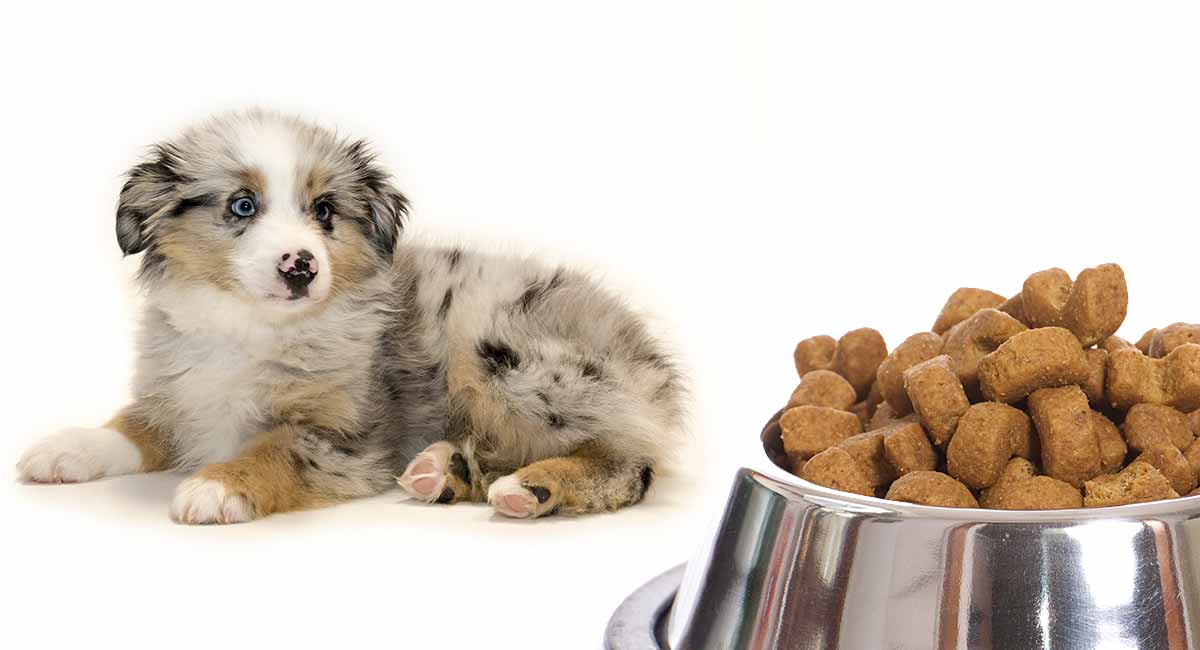
This is a straightforward guide to feeding an Australian Shepherd Puppy. We’ll look at when to feed, how often to feed and how much to feed. We’ll explore how your Australian Shepherd puppy’s nutritional needs will change as they grow and look at the benefits and drawbacks of different diets.
Introducing a new Puppy Food Brand
On bringing your new Australian Shepherd puppy home, keep feeding the same food for at least two or three weeks. Dogs’ digestive systems are quite delicate and abrupt changes to their diet can result in tummy troubles. Canines don’t adapt to different foods the same way humans do and modifications to their food must be done gradually.
When you do decide to change puppy food brands it should be done by mixing increasing amounts of the new food into the old for five to seven days. Start with mixing three-quarters of the current food with a quarter of the new food for the first two to three days. Then give him equal portions of the old and new food for the next two or three days.
Finally, for the last two or three days, you should have three-quarters of the new food and one-quarter of the old food. By this time they should be acclimated to the new diet. If you see signs of an upset stomach, slow or stop the transition. Vomiting, diarrhea, excessive gas, or loss of appetite are signs to watch out for.
Australian Shepherd Puppy Diets
When it comes to feeding an Australian Shepherd puppy, the right food plays a crucial role in their development. In the first few months of their life, they grow rapidly as their bones get bigger, muscles get stronger, and their immune systems develop.
Growing puppies and young adult dogs actually need more calories than older dogs of the same size. A high-quality, nutrient-dense diet specifically formulated for puppies will support this accelerated rate of development. When searching for a puppy food, whole meat proteins like chicken, beef, and lamb should be listed as the first several ingredients.
Healthy fats are a good source of energy for growing puppies while omega-3 fatty acids help to keep their skin and coat healthy. DHA (docosahexaenoic acid) is an omega-3 fatty acid known for encouraging strong brain development. Although commercial foods will offer feeding guidelines on their packaging, you may want to consult with a vet, since the optimal portion size can vary from puppy to puppy.
How Feeding Changes As You Puppy Gets Older
When you bring your puppy home they will be growing very fast indeed, so at this point the puppy needs a substantial quantity of food per pound body weight. As your puppy grows rate of growth slows so that the quantity of food they need as they get bigger, does not increase as much as you might think it would! But, because many puppies have sensitive digestions, their daily food allowance needs to be divided into several small portions.

What Should you Feed an Australian Shepherd Puppy?
When you’re walking up and down the pet food aisle in your grocery store the sheer amount of choice can be overwhelming. That’s not even including brands that are exclusively available through specialty pet stores or your veterinarian’s office.
To make things even more complicated, there’s also home-cooked and raw diets to consider. We’ve broken down the main options into four categories:
- kibble
- wet food
- raw (BARF)
- homemade
Of course, each Australian Shepherd puppy diet has its own pros and cons. We’ll take a look at each one separately to help you make an informed choice.
Feeding an Australian Shepherd Puppy Kibble
Dry kibble is without a doubt the most popular puppy food and it’s the easiest, cheapest, and most readily available option. As long as you’re choosing a high-quality brand that provides the proper nutrition for a growing puppy there’s nothing wrong with this choice.
However, there are numerous brands of varying quality and many of the inexpensive ones won’t be as healthy.
Some dry kibble can be loaded with cheap fillers and preservatives. The benefits of dry food include being easy to serve and store. Kibble may be somewhat better for your puppy’s teeth than commercially prepared wet food, simply because the crunchy surface has a more abrasive action. However, all commercial food contain carbohydrates and dogs fed on them benefit from regular teeth brushing.
Feeding an Australian Shepherd Puppy Wet Food
Although more expensive, many puppies will like the taste of canned wet food over that of dry kibble.
So, if you have a puppy who isn’t eating, serving wet food might solve this problem. Other benefits are that it usually contains less preservatives, has a higher percentage of protein, and may have fewer carbohydrates than dry food.
On the downside, it’s considerably more expensive and once it’s opened it can’t be stored for very long.
Australian Shepherds who are fed wet food exclusively will likely need more attention paid to their teeth and gums. Another option is to combine dry and wet food as this gives them a semi-moist meal with the benefits of both kinds of food.
Feeding an Australian Shepherd Puppy Raw (BARF)
Although some people choose to feed their Australian Shepherd puppy raw food, this diet is not without controversy. Before dogs were domesticated, they would eat raw meat and bones in the wild. Advocates will claim that there are numerous health benefits to dogs eating a raw diet, including:
- boosting the immune system
- improving digestion
- cleaner teeth
- healthier skin and coat
However, some experts claim that a raw diet that includes raw chicken poses a risk of salmonella infection. Although a raw diet is packed with protein, it will have to be carefully balanced with other food sources to ensure nutritional balance.
Those opposed to raw feeding also claim that bones can be a choking hazard. And there’s also a concern that bone fragments can cause an intestinal blockage or internal puncture. All these concerns are addressed in our main raw feeding article
If you feel that a raw diet is the right one for your Australian Shepherd puppy, it’s important to consult with your veterinarian to ensure it will meet their nutritional needs.
Bear in mind that committing to a raw diet will require special preparation and storage requirements. Proper handling and cleaning practices will need to be used to reduce the chances of bacterial contamination. But this is no different from the way you would handle raw meat you prepare for your family.
Homemade Diets
Choosing to feed your Australian Shepherd puppy a cooked homemade diet can be time-consuming. You’ll need to be extremely well-versed in all the nutrients a puppy needs to grow and develop properly.
This is a big responsibility because even a small imbalance or deficiency can lead to health problems. Although one benefit of a homemade diet is that it allows you to know exactly what ingredients you’re feeding your dog.
How Much Should I Feed My Australian Shepherd Puppy?
When it comes to how much you should feed your Australian Shepherd puppy there are a number of factors to consider. Every dog’s metabolism is different. Use the quantities on the packet as a rough guideline, but bear in mind that many puppies do not need as much as the recommended guidelines. The puppy’s age, size, and activity level, as well as the type of food and brand, can make a difference in the amount of food they should get.
Purina recommends that a dog in this weight range should get 2/3 to 2 cups of food per day when they’re between one and three months old.
- From four to five months of age, they should get 1 ¾ to 3 ⅓ cups.
- At six to eight months it should be 1⅓ to 3 ¼ cups.
- By nine to eleven months it increases from 2⅓ to 4 cups.
- Between the ages of one and two years old, they will get 2⅓ to 5 ¼ cups each day.
Speaking with your veterinarian is the best way to ensure your puppy is eating the right amount. As you can imagine, there’s a big variance in the amount of calories burned between a dog who’s out herding all day and one who lounges around the house. These medium-sized herders are an agile, rugged working breed. Descended from a line of Europe’s finest sheep herders, Australian Shepherds tend to have a high-energy level and require one to two hours of daily exercise. If your Australian Shepherd doesn’t run and play a lot, this should be taken into consideration. Dogs who aren’t as active require fewer calories. It’s important to be aware of your dog’s physical condition and keep track of their weight.
Mealtime Schedule
At 8 weeks old your puppy should get at least four meals a day. Just weigh out their daily food ration each morning, and divide it into four portions. At three months old, most puppies can drop down to three portions. You’ll know if you have made this move too early as your puppy will likely get an upset tummy.
 (paid link)
 At six months your pup can drop down to two meals. Some dogs remain on two meals a day for the rest of their lives. Others do well on one meal a day from the time they’re a year old.
Is My Puppy the Right Weight?
Despite being active, the Australian Shepherd has a hearty appetite and can put on weight quite easily.
Australian Shepherds are also prone to hip dysplasia. This orthopedic disorder leads to lameness and painful arthritis and carrying around extra pounds can exacerbate it.
In addition to increasing the risk for hip dysplasia, being overweight also puts your puppy at a higher risk for heart-related problems, diabetes, and cancer.
This article will give you more information about how much a puppy should weigh throughout his first year. But sometimes checking by eye and touch is a better way to gauge if your puppy is the proper weight.
You should be able to feel his ribs easily by putting your hands on either side of his ribcage. And his abdomen should tuck in slightly when looking at him from the side. However, your puppy’s ribs shouldn’t be visible. If they are, he’s probably underweight.

Joe says
Can’t seem to locate much as to how long to feed an Aussie pup puppy foog
Ken says
Can’t find it either. My vet says puppy food for a year.
Alan Campbell says
I’m Raising two mini aussies. Love ’em! Rocky and Ziggy. now 29 wks old. struggling with what to feed. they stopped eating Purina Puppy Chow at 4.5 mo because I dont think they like it. they were raised on it until about 4.5 mo. I switched to Hills science diet puppy kibble and try to add variety and content by mixing a small quantity (1/3 cup) of boiled chicken or raw beef plus a little canned Hills SD for sensitive stomachs (chicken stew or turkey pate’). I went w/ Hills sensitive stomach on vet advice because Rocky ate a bunch of gravel @ 8 weeks and I think he has some scarring. Total 1 1/3 cup x 2 times daily. I have noticed some softer stools lately. Is this advisable or excessive? They usually eat it right down and seem to like the mix. Please give opinion. Al Campbell
Galen says
“This orthopedic disorder leads to lameness and painful arthritis and carrying around extra pounds can exasperate it.”
I may come off as a grammarian but I think the word you want is exacerbate not exasperate 🙂
Pippa Mattinson says
Well spotted! That’s now been corrected, thanks 🙂
Kylie Williams says
My dog Hazel was recently diagnosed overweight. She is an Aussie mix and almost two years old now at 38.1 pounds. They say the normal range for her to be is 32. I was wondering how much I should feed her to help her lose weight safely. She is supposed to go on a prescription diet to help her feel full but I am trying to see what I can do first. Thank you for your time.
Mark says
My father in-law has 3 pups left 4 weeks old wonderful looking pups
Mary says
My Australian miniature puppy won’t eat his kibbles without homemade chicken or other cooked food in it.
Deeann Van Luven says
We are looking for Australian puppy please if you have any could you contact us
Joanie Crews says
Did you ever find an Aussie puppy? My family just got two beautiful Aussie puppies from a great breeder. I have a feeling you must have found a puppy since I just realized that this post was from March.